Tuesday, 20 April 2010

Questionnaire


Questionnaire results


Tuesday, 9 February 2010

Preliminary Task


Tuesday, 2 February 2010

Storyboard & working script

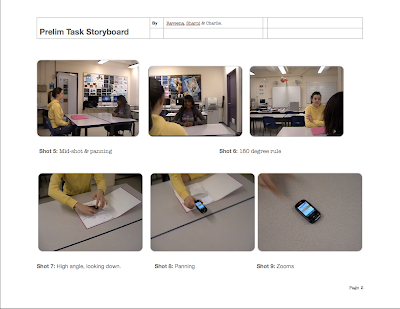
In Media, we have been planning our shots for making films through storyboards. In the prelim task we've shown our use of 'the 180 degree rule', 'shot reverse shot' and 'match on action' shots. The following is an uploaded storyboard in photographic form. 


Working Script:

Shot 1: There is a young female walking down the corridor.

Shot 2: The young female continues on her way to the classroom.

Shot 3: The young female gets closer to the classroom.

Shot 4: The young female opens the door.

Shot 5: She walks into the classroom and sits down on a chair.

Shot 6: The young female questions the suspect sitting opposite her at the table.

        Young female: “Let me get this straight... You had nothing to do with the murder?”

Shot 7: The suspect responds. 

        Suspect: “How many times do I have to tell you! I was nowhere near the house that night.”

Shot 8: Young female continues to question suspect.

        Young female: “Then how do you explain this then?!” 

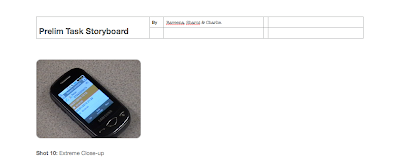
Shot 9: Young female takes out the evidence and places it on the table in front of the suspect.

Monday, 23 November 2009

Opening Sequence Analysis -What Lies Beneath


Camera Shot/Angle/Movement
In the opening sequence of ‘What Lies Beneath’ the camera seems to be floating through grim, foggy and murky water creating an eerie and creepy feel. A close up shot is used on the woman in the bath as she releases her head from under the water. This shot allows the audience to capture the image of her head underneath the water where her face looks grotesque, patchy and near-death. It also allows viewers to notice the water spiraling around her head before she gasps for air; the circular motion implies suffocation. A long shot is used to show the mise en scene of the bathroom with the woman soaking in the bath. Medium shots are predominantly used, focusing on the female protagonist. The medium shots establish that she is in a bathroom but does not show too much of her surroundings which creates an enigma. The camera zooms in on the protagonist, portraying her significant role in the film. The medium shot shows the woman using the hairdryer on the steamy mirror, the camera then pans to the woman’s face to show her state of frustration when the appliance stops working. A close up shot of the woman’s hand going to switch the plug on/off is vital as it clearly shows the label on the appliance with a diagram explaining that using a hairdryer in a bathroom should be avoided. Consequently, an electric shock is produced. The fact she is using it shows she is careless and prepares the audience for upcoming trouble as well as the fact that she continues as if the electric shock isn’t a problem or going to repeat itself.

Sound
The non-diegetic soundtrack is an orchestral piece which is conventional of a thriller genre. The piano notes played are constant and make the audience feel as though something horrifying may happen. The violins are high pitched, similar to a screeching sound, disturbing the viewer. Also, a howling sound is stimulated to sound ghost-like giving a chilling effect on the audience. Towards the end of the orchestral piece, the sound increases in volume with what sounds like whispers. The whispers aren’t clear to understand which creates tension and grabs the audience’s attention. The diegetic sound of the woman gasping for air after raising her head out of the bath makes people wonder why as it’s quite abnormal for a bath to have that effect on you when usually it is to relax you. She sighs as if she is relieved further provoking the audience to want to know what happened because they feel as though they’re not being told everything. The diegetic sound of the water dripping, splashing and flowing in the bath is heard very clearly and is focused on a lot. It suggests that water will play a great role in the film later as the credits were under water and the woman was shown in the bath.

Editing
Slow cuts are used during the credits of ‘What Lies Beneath’ placing emphasis on the intense music and foggy graphics. The next cut is deliberately long for the viewer to absorb as much of the mise en scene and narrative plot as possible because not a lot is given away. It flows smoothly into the next cut, which is fairly long focusing on the significance of the hairdryer, which is clear when the next cut is abrupt, showing the power shortage. It quickly cuts to the protagonist’s face showing her shocked reaction.

Mise en Scene
There is a murky lake shown during the credits insinuating it could be of great importance in the film later on. This slowly sets the scene for the viewer and puts them on edge already at the beginning of the film. The dark, grim, dreary lighting of the lake scenery contrasts with the bright lighting and white background of the protagonists bathroom. Everything in the bathroom appears to be neat and tidy implying she's an organised and clean person. Other connotations of white suggest she is a pure, innocent stable woman. However, white is associated with hospitals, doctors, and sterility which could be a hint for connection in the later parts of the film. Another implication for the colour white is ghosts which could also foreshadow later events. The steam in the bathroom could possibly suggest an upcoming whilst the hairdryer symbolising the characters fight against it. The bath in which she is in symbolises death as it is coffin shaped and is also a confined space.

Characters
The woman is clearly the protagonist as the camera focuses on her a lot. Her being naked could symbolise vulnerability and her exposure to danger throughout the rest of the film. She seems to generally be associated with danger as she is using an electrical appliance in the bathroom where it shouldn’t come in contact with water.

Locations
The first two minutes roughly, is filmed in one location, the bathroom. The bathroom seems to be a tranquil, calm place until the hairdryer fuses a spark and it alarms the protagonist.

Narrative/Plot
What lies beneath is a narrative based film. We realize this because the audience learns nothing about the characters from the first couple of minutes from the scene, but from the mysterious momentary power out-age and electric shock from the mains switch, the viewer realises that danger is brooding.

Themes
Electrocution, suffocation, lake, suspense, thriller, horror, mystery, bath tub, drowning,

Visual Style
What Lies Beneath has an individual style as the title ‘What Lies Beneath’ is screened in a simmering water effect way.

Genre
It's clear that the genre is thriller because the opening sequence of What Lies Beneath sticks to the conventions of a thriller film and creates enigma. Eg. Naive, vulnerable woman alone.

Comparative Opening Sequence Analysis - Se7en & Panic Room

Camera Shot/Angle/Movement
The opening sequence of ‘Seven’ predominantly uses close ups and extreme close up shots. Whereas, in the opening of ‘Panic Room’, long shots and wide shots are used. Unlike ‘Seven’, a high-angled shot is used in ‘Panic Room’.

Sound
Both Seven and Panic Room use non-diegetic sounds in the opening sequences. Seven uses random sharp metal sounds stimulated to sound like screeching or human screams. Also, the tempo of the sound increases. In comparison, Panic Room is calmer than Seven as it’s not as erratic and as random. An orchstral piece is used in Panic Room where the dynamics of the violins get louder. Also, a ticking clock is used.

Editing
Seven consists of many rapid, erratic cuts, which are disorientated and fragmented. However, Panic Room uses slow, sedate cuts allowing the audience to absorb all of the information where the cuts last longer.

Mise en Scene
In the opening of Seven, the objects in the scene are a key part to the film. There is clearly a collection of books, a knife, scrapbook and razor blade; all of which inside a laboratory or secretive room. Whereas, Panic Room is of the city consisting of buildings, the blue skyline and cars, especially yellow taxis.

Characters
In Seven there is clearly an antagonist present as activity of the character is shown throughout the opening sequence. In contrast, Panic Room has no established characters.

Locations
Seven is located in a photography lab or secretive room as we see the antagonist carry out some work unlike panic room, where it is located in New York City. However, in the same way that Seven is located in one place, Panic room is also located in just once place which connotes a sense of confinement and terror.

Narrative/Plot
Both Seven and Panic Room’s plot are not entirely clear to the audience but we have some sort of implication from images of the scrapbook in Seven that it is related to the suffering of one and murder cases. In Panic Room it is also images that suggest a plot as the billboard in the city of the women imply the victims are women and the billboard of the couple suggest the relationship between them may be broken.

Themes
Both films have very similar themes such as suspense, thriller, death, murder, danger, suffering.

Visual Style
Both opening sequences have individual and unique styles. Seven has a unique and original style as there are unsettling sounds, graphics and titles that are done in a distinct way. Similarly, Panic Room’s style is unique, due to the graphics displayed on and across buildings. This is rarely seen in films.

Genre
The genre of ‘Seven’ is more clearly established than Panic Room as there are disturbing graphical and violent images indicating a horror/thriller category. Panic Room’s plot is ambiguous which conveys the genre of mystery and thriller.

Opening Sequence Analysis - Children Of Men

(Click here to view the opening sequence.)

Camera Shot/Angle/Movement

The long shot, high-angle at the beginning that lasts over 15 seconds is a point of view of a point of view shot as the audience is watching them watching something else. This allows us to detect the seriousness on their face. Viewers can sense something’s wrong. The point of view shot then followed is used to allow audiences to absorb the information in and also have empathy with the news. The tracking and long shot has been used to allow the audience to identify themselves with the protagonist of the film. When this is used on the protagonists back, the camera goes around the shop, without him on camera but then pans to him. The 180 degree shot has been used to engage the audience because the audience becomes more emotionally involved as it creates mystery. The camera goes around the shop to emphasise the mise en scene. The camera work becomes unsteady and shaky suggesting that a handheld camera is used. The shakiness of the camera increases realism and shows that the situation is no longer calm. It creates mystery and tension. Viewers are left wondering if the protagonist is a man hunted. For an opening scene to consist of just 3 shots is different to many other films. The shots have deliberately been made longer for the audience to absorb the information. The way in which the camera tracks the protagonist out of the coffee shop but loses him on the camera yet pans across to him is done differently because the director could have simply cut as soon as the protagonist was off scene rather than pan over.


Sound
The diegetic use of the news broadcast acts as a narrator for the film plot. The director has chosen this way to inform the audience of what’s happening before the scene even begins. The diegetic sound of the cars and engines are used by the directors to give the film a sense of realism because it’s most common sound heard by people every day whether they’re on the way to the shops, work or college therefore, it reinforces the feel of every day life. The non-diegetic sound of the violins plays soft, sad music and reflects the sad news and puts the viewer in a sympathetic and touched mood. The diegetic sound of the bomb exploding is followed by diegetic sounds of shrieks and screams which sends an urgent message across to the audience conveying that something isn’t right. These sounds connote danger, alert and tension.


Editing
The editing is linear; there are not many cuts in the opening apart from one where the camera focuses on the news bulletin in the coffee shop. There are only 3 shots; 1 long shot, 1 point of view shot and 1 tracking shot. It represents a sense of continuity possibly suggesting the problem is on going and never ending. It gives it that sense of tension of mystery as well. The pace is fairly slow until the protagonist walks out of the coffee shop and the bomb explodes. The pace gets quicker at these points.

Mise en scene
The mise en scene is very crowded and cramped as everyone is gathered in one tiny coffee shop. The viewer wouldn’t expect to see so many people standing gathered in a coffee shop which implies something worrying, urgent and not quite right is happening. There are many different people in the shop. For example, a couple, grandmother, policemen, black men, working class etc. The city has been made busy with buses and bikes riding by in London. People usually grab a coffee before they head off to work in the morning and as everyone is gathered in the coffee shop, it implies it is morning time as well as the chaotic busy streets outside suggesting rush hour. Also, one of the extra’s in the coffee shop vaguely looks down at their watch as if checking the time because they’re either already late or going to be late for work. The text says the current date of the day in the film ‘...2027’ which allows the audience to establish we are in the future. The sense of London has been brought across very well to the audience because the red buses that are passing by on the streets are typical of representing the London city.

Characters

The opening scene shows a man who clearly seems to be the main protagonist as the camera tracks him a lot. However, he isn’t definitely the protagonist of the film because he doesn’t fit the expectations fully of a hero. He not only drinks coffee and alcohol together first thing in the morning, but when the bomb explodes he backs away when a “hero” is expected to help the old lady near the explosion. Furthermore, when everyone is gathered in the coffee shop, they’re engaged by the news however, the protagonist walks in, orders his coffee and walks straight back out without a care. 


Locations

The opening scene is predominantly filmed in the coffee shop where the news is announced. The next location is outside where the bomb explodes. 

Narrative/plot
 The beginning of the opening of ‘children of men’ tells the story and gives insight on the issue. It seems like a documentary type of film. It’s 2027 on 16th Nov’ and due to the chemical war/virus, women are being represented as infertile. The concept of female infertility is used as a "metaphor for the fading sense of hope" in the film. The future is represented as destructed, dark, depressing and not stable to live in long term as the news bulletin is alarming and sad. It informs the world that the youngest human has died at 18 years of age.

Themes
Infertility, pregnancy, terrorism, destruction, religion, hope, loneliness, loss. 


Visual style

The visual style is unique in the sense that it’s narrative based in the beginning so the story is being told as the credits roll. However, the text and font is displayed in a simplistic way with white text on a black background. 

The director uses a series of mid shots but the most significant shot used is the continuous shot as it lasts 50 seconds. This is rarely done due to the hard work it takes as it's difficult to get right.

Genre
It falls into the ‘Thriller’ category as it portrays intensity when the camera only shows the protagonists back, tracks him, the bomb explodes and the screams are heard plus many more. This is the same for the genre of ‘Mystery’ because we currently have no idea who this man is, what his role is and whether or not he’s hunted or wanted. We are oblivious as to why the bomb has been set off or if it was deliberate or not. 
As the news informs the audience of the science of the future, one of the genre’s I feel it falls into is ‘Science’ and also ‘Technology’ as advanced technologies are shown in the opening. This ties in with the genre of ‘Survival’ because the world will not be able to survive unless the environment is cared for or if women are somehow made fertile again. 
Another genre it can fall into is 'Action' due to the bomb explosion. The audience expects more of this type of event to happen again.