Friday, 30 April 2010

What Have You Learnt About Technologies From The Process Of Constructing Products?


Above are still images from various thriller films produced by Alfred Hitchcock. When researching ideas for our thriller, we discovered how Hitchcock extended his work into the 1940's in a number of brilliant black and white films which resulted in great recognition and success in his name. In admiration, we decided to film our thriller in aim of using a black and white effect on Final Cut Pro.


List of Black & White films:

  • The Lady Vanishes (1938)- with Margaret Lockwood, Michael Redgrave, May Whitty
  • Rebecca (1940)- with Joan Fontaine & Lawrence Olivier
  • Foreign Correspondent (1940)- with Joel McCrea & Laraine Day
  • Suspicion (1941)- with Joan Fontaine & Cary Grant
  • Shadow of a Doubt (1943)- with Teresa Wright & Joseph Cotton
  • Saboteur (1942)- with Robert Cummings & Priscilla Lane
  • Spellbound (1945)- with Ingrid Bergman & Gregory Peck
  • Notorious (1946)- with Ingrid Bergman & Cary Grant
  • Stagefright (1950)- with Jane Wyman & Marlene Deitrich
  • Strangers on a Train (1951)- with Farley Granger, Robert Walker, Ruth Roman
  • Psycho (1960)- with Anthony Perkins, Vera Miles, Janet Leigh

    Editing Software helped us to create this black and white ef
    fect. Using Final Cut Pro, we went to 'Filters' and then 'Effects' and finally applied the 'Desaturate' to the whole selection of the film.


    Then we applied an overlapping effect by lowering the transparency level on the selected clip which is circled in the screenshot below. This was done in order to emphasise that it is a dream as she is tossing and turning whilst the images overla
    p.  


    We then used a camera flash effect in her dream of the fire and newspaper article to give the impression of memory re
    lapse and an uncomfortable nightmare. We selected 'dip to colour dissolve' effect and selected the appropriate timing. 


    Another effect used was the 'blur' effect for when the young woman wakes up from her bad dream and looks around in disbelief. The blur was used to show her vision as unsteady and her mind being all over the place. The type of blur we used was 'radial blur' because in comparison to the other blurs it made it
     seem more realistically chaotic. 


    The most complex effect used which we feel gave our thriller the most edge was the cloning effect because it really showed the female's psychological state of mind. When filming, we filmed the actress with continuity in mind as if we had placed her on a different background then it wouldn't have worked because we needed to put the hallucination in the mirror. 
    We cropped the selection needed and then placed it into the mirror clip and positioned it so viewers could see the hallucination clearly. For the transition to have been smooth, we used the 'fade in/fade out dissolve' effect. 


    Wednesday, 21 April 2010

    Ratings

    The BBFC defines the age certificate of 15 as :
    Passed only for persons of fifteen years and over. No person apparently under the age of 15 years shall be admitted to any exhibition at which there is to be shown any film which has received a '15' certificate from the British Board of Film Classification.
    The BBFC has strict guidelines on what should be in a film which has a certificate of 15:

    Theme: No theme is prohibited, provided the treatment is appropriate to 15 year olds.
    Language: There may be frequent use of strong language; the strongest terms are only rarely acceptable. Continued aggressive use of strong language and sexual abuse is unacceptable.
    Nudity: There are no constraints on nudity in a non-sexual or educational context.
    Sex: Sexual activity and nudity may be portrayed but without strong detail. The depiction of casual sex should be handled responsibly. There may be occasional strong verbal references to sexual behaviour.
    Violence: Violence may be strong but may not dwell on the infliction of pain, and of injuries. Scenes of sexual violence must be discreet and brief.
    Imitable techniques: Dangerous combat techniques such as ear claps, head-butts and blows to the neck are unlikely to be acceptable. There may be no emphasis on the use of easily accessible lethal weapons (in particular, knives).
    "There are scenes of knife use in our film but the scenes........"
    Horror: Sustained or detailed infliction of pain or injury is unacceptable.
    Drugs: Drug taking may be shown but clear instructive detail is unacceptable. The film as a whole must not promote or encourage drug use.


    15 means that the film, video or DVD is really only suitable for those aged 15 or above. Only people aged 15 or older are allowed to view a 15 rated film at the cinema or buy or rent a 15 rated DVD, video or game.


    Tuesday, 20 April 2010

    Questionnaire


    Questionnaire results


    Tuesday, 9 February 2010

    Preliminary Task


    Tuesday, 2 February 2010

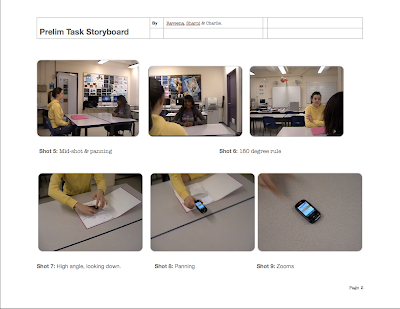
    Storyboard & working script

    In Media, we have been planning our shots for making films through storyboards. In the prelim task we've shown our use of 'the 180 degree rule', 'shot reverse shot' and 'match on action' shots. The following is an uploaded storyboard in photographic form. 


    Working Script:

    Shot 1: There is a young female walking down the corridor.

    Shot 2: The young female continues on her way to the classroom.

    Shot 3: The young female gets closer to the classroom.

    Shot 4: The young female opens the door.

    Shot 5: She walks into the classroom and sits down on a chair.

    Shot 6: The young female questions the suspect sitting opposite her at the table.

            Young female: “Let me get this straight... You had nothing to do with the murder?”

    Shot 7: The suspect responds. 

            Suspect: “How many times do I have to tell you! I was nowhere near the house that night.”

    Shot 8: Young female continues to question suspect.

            Young female: “Then how do you explain this then?!” 

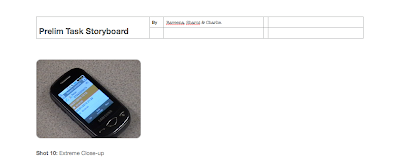
    Shot 9: Young female takes out the evidence and places it on the table in front of the suspect.

    Monday, 23 November 2009

    Opening Sequence Analysis -What Lies Beneath


    Camera Shot/Angle/Movement
    In the opening sequence of ‘What Lies Beneath’ the camera seems to be floating through grim, foggy and murky water creating an eerie and creepy feel. A close up shot is used on the woman in the bath as she releases her head from under the water. This shot allows the audience to capture the image of her head underneath the water where her face looks grotesque, patchy and near-death. It also allows viewers to notice the water spiraling around her head before she gasps for air; the circular motion implies suffocation. A long shot is used to show the mise en scene of the bathroom with the woman soaking in the bath. Medium shots are predominantly used, focusing on the female protagonist. The medium shots establish that she is in a bathroom but does not show too much of her surroundings which creates an enigma. The camera zooms in on the protagonist, portraying her significant role in the film. The medium shot shows the woman using the hairdryer on the steamy mirror, the camera then pans to the woman’s face to show her state of frustration when the appliance stops working. A close up shot of the woman’s hand going to switch the plug on/off is vital as it clearly shows the label on the appliance with a diagram explaining that using a hairdryer in a bathroom should be avoided. Consequently, an electric shock is produced. The fact she is using it shows she is careless and prepares the audience for upcoming trouble as well as the fact that she continues as if the electric shock isn’t a problem or going to repeat itself.

    Sound
    The non-diegetic soundtrack is an orchestral piece which is conventional of a thriller genre. The piano notes played are constant and make the audience feel as though something horrifying may happen. The violins are high pitched, similar to a screeching sound, disturbing the viewer. Also, a howling sound is stimulated to sound ghost-like giving a chilling effect on the audience. Towards the end of the orchestral piece, the sound increases in volume with what sounds like whispers. The whispers aren’t clear to understand which creates tension and grabs the audience’s attention. The diegetic sound of the woman gasping for air after raising her head out of the bath makes people wonder why as it’s quite abnormal for a bath to have that effect on you when usually it is to relax you. She sighs as if she is relieved further provoking the audience to want to know what happened because they feel as though they’re not being told everything. The diegetic sound of the water dripping, splashing and flowing in the bath is heard very clearly and is focused on a lot. It suggests that water will play a great role in the film later as the credits were under water and the woman was shown in the bath.

    Editing
    Slow cuts are used during the credits of ‘What Lies Beneath’ placing emphasis on the intense music and foggy graphics. The next cut is deliberately long for the viewer to absorb as much of the mise en scene and narrative plot as possible because not a lot is given away. It flows smoothly into the next cut, which is fairly long focusing on the significance of the hairdryer, which is clear when the next cut is abrupt, showing the power shortage. It quickly cuts to the protagonist’s face showing her shocked reaction.

    Mise en Scene
    There is a murky lake shown during the credits insinuating it could be of great importance in the film later on. This slowly sets the scene for the viewer and puts them on edge already at the beginning of the film. The dark, grim, dreary lighting of the lake scenery contrasts with the bright lighting and white background of the protagonists bathroom. Everything in the bathroom appears to be neat and tidy implying she's an organised and clean person. Other connotations of white suggest she is a pure, innocent stable woman. However, white is associated with hospitals, doctors, and sterility which could be a hint for connection in the later parts of the film. Another implication for the colour white is ghosts which could also foreshadow later events. The steam in the bathroom could possibly suggest an upcoming whilst the hairdryer symbolising the characters fight against it. The bath in which she is in symbolises death as it is coffin shaped and is also a confined space.

    Characters
    The woman is clearly the protagonist as the camera focuses on her a lot. Her being naked could symbolise vulnerability and her exposure to danger throughout the rest of the film. She seems to generally be associated with danger as she is using an electrical appliance in the bathroom where it shouldn’t come in contact with water.

    Locations
    The first two minutes roughly, is filmed in one location, the bathroom. The bathroom seems to be a tranquil, calm place until the hairdryer fuses a spark and it alarms the protagonist.

    Narrative/Plot
    What lies beneath is a narrative based film. We realize this because the audience learns nothing about the characters from the first couple of minutes from the scene, but from the mysterious momentary power out-age and electric shock from the mains switch, the viewer realises that danger is brooding.

    Themes
    Electrocution, suffocation, lake, suspense, thriller, horror, mystery, bath tub, drowning,

    Visual Style
    What Lies Beneath has an individual style as the title ‘What Lies Beneath’ is screened in a simmering water effect way.

    Genre
    It's clear that the genre is thriller because the opening sequence of What Lies Beneath sticks to the conventions of a thriller film and creates enigma. Eg. Naive, vulnerable woman alone.